

Data Scientist vs Data Engineer vs Statistician: What Each Role Actually Does
If you are exploring data careers in South Africa, it can feel unclear where one role ends and another begins.
You may see job titles like Data Scientist, Data Engineer and Statistician used interchangeably, sometimes with overlapping requirements. Yet these are distinct career paths. Each plays a different role in how organisations collect, manage and interpret data.
Understanding the differences can help you choose a direction that fits your strengths, interests and long term goals.
Why these roles exist in the first place
Most organisations want to use data to make better decisions. That could mean improving customer experience, forecasting demand, reducing costs or identifying new opportunities.
But turning raw data into insight requires different types of work:
- someone builds the systems that store and organise the data
- someone analyses the data and builds models
- someone ensures the conclusions are statistically sound
In some companies these roles are separate. In others, especially smaller businesses, one person may take on elements of more than one role.
What does a Data Scientist do?
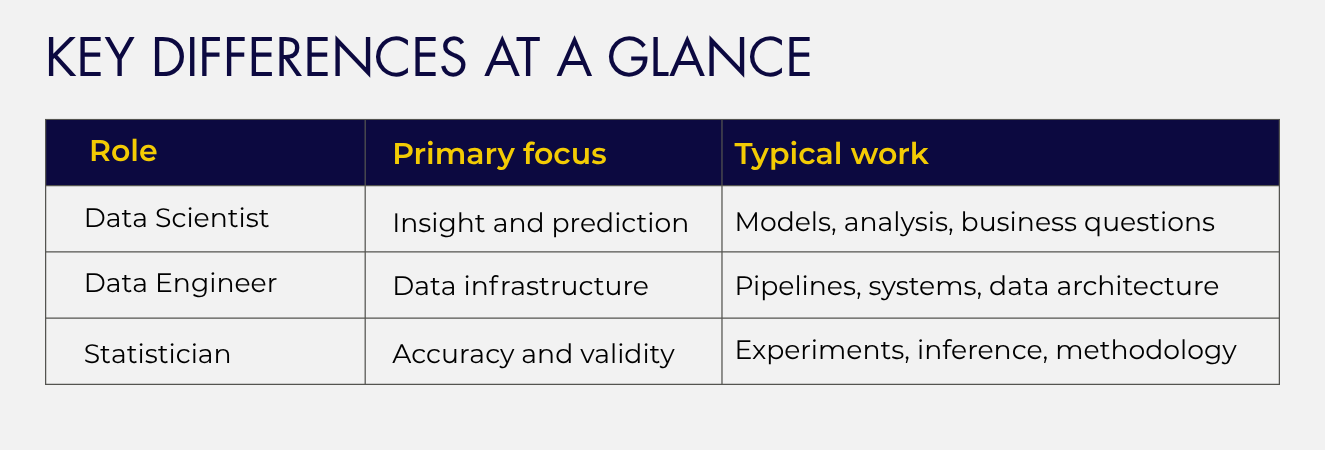
A Data Scientist uses data to answer business questions, uncover patterns and build models that support decision making.
Typical responsibilities include:
- cleaning and preparing data
- exploring trends and relationships
- testing hypotheses
- building predictive or machine learning models
- interpreting results for business use
- presenting findings through dashboards or reports
A data scientist might work on questions such as:
- Which customers are likely to leave?
- What pricing strategy will improve revenue?
- Which marketing channels perform best?
- Which candidates are most likely to succeed in a role?
This career suits people who enjoy combining analytical thinking with problem solving and real world application.
Common skills for Data Scientists:
- statistics and probability
- Python or R
- SQL
- data visualisation
- machine learning fundamentals
- critical thinking
- communication and storytelling with data
A strong data scientist does not only build models. They translate results into clear, practical insights that others can act on.
What does a Data Engineer do?
A Data Engineer focuses on building the systems that make data usable.
While data scientists work with insights, data engineers work with the infrastructure behind the scenes. They ensure data flows correctly, is reliable, and is accessible when needed.
Typical responsibilities include:
- building data pipelines
- integrating data from multiple sources
- designing data warehouses or data lakes
- improving data quality and consistency
- managing large scale data processing
- supporting analytics and reporting teams
Without well structured data, analysis becomes slow, inconsistent and difficult to trust. This is where data engineering plays a central role.
Common skills for Data Engineers
- SQL and database design
- Python, Scala or Java
- ETL and ELT processes
- cloud platforms
- data architecture concepts
- version control and testing
This path suits people who enjoy building systems, solving technical challenges and working with large scale data environments.
Do you need an engineering degree to become a Data Engineer?
No.
Despite the title, a formal engineering degree is not a requirement. Many data engineers come from computer science, information systems, mathematics or statistics backgrounds. Others transition from software development or build their skills through practical experience.
What employers look for is your ability to work with data systems, write clean code, and manage data at scale.
What does a Statistician do?
A Statistician focuses on how data is collected, analysed and interpreted with rigour.
Their work centres on ensuring that conclusions drawn from data are valid, reliable and free from bias.
Typical responsibilities include:
- designing surveys or experiments
- selecting appropriate statistical methods
- analysing data using statistical models
- quantifying uncertainty
- interpreting results in context
A statistician might work on questions such as:
- Is this result statistically significant?
- Is the sample representative of the population?
- Can we trust this conclusion, or is it due to chance?
This career suits people who enjoy theory, precision and understanding how conclusions are formed.
Common skills for Statisticians
- statistical theory
- probability
- R, Python or specialised statistical tools
- experimental design
- data interpretation
- attention to detail
Statisticians often work in research, finance, healthcare, government and any field where accuracy and validity are essential.
Which path should you choose?
If you are unsure which direction fits you best, start with how you like to think and work:
- If you enjoy solving business problems with data and building models → Data Scientist
- If you enjoy building systems and working with data pipelines → Data Engineer
- If you enjoy theory, precision and analysing uncertainty → Statistician
It is also worth noting that careers can evolve. Many professionals move between these roles as they gain experience.
Final thought
There is no single “best” data career. The right choice depends on your strengths, interests and the kind of work you find energising.
The most effective teams often bring these skill sets together. When data is well structured, carefully analysed and thoughtfully interpreted, it becomes far more powerful.